
Quick Summary
Quick Summary
- No single government template exists: every full-time employment contract must comply with the Fair Work Act 2009, the 10 NES minimum entitlements and the applicable modern award.
- A compliant template needs 10 core clauses, from classification and pay to confidentiality, restraints and termination notice.
- Any clause that pays less than the award or the NES is unenforceable, even if the employee signed it.
- Free overseas templates embed at-will employment and notice rules that have no legal force in Australia.
- Employers must give every new employee the Fair Work Information Statement before, or as soon as practicable after, they start.
You have just hired your first full-time employee, the start date is looming, and you need an employment contract template that actually works in Australia. Here is the direct answer: there is no single government-issued full-time contract template, because every employment relationship is shaped by the Fair Work Act 2009, the National Employment Standards (NES) and whichever modern award covers the role. A safe template covers the 10 core clauses, and you adapt it to the award, not the other way around.
For Australian employers with 1 to 250 staff, a well-drafted full-time employment contract does three jobs at once: it locks in agreed terms, it protects you if the relationship sours, and it proves compliance if the Fair Work Ombudsman comes asking. This guide walks through every clause a compliant template needs, where free templates fall short, and how to customise one without a lawyer on retainer. You can also download ready-made free employment documents and adapt our full library of employment agreement templates for your business.
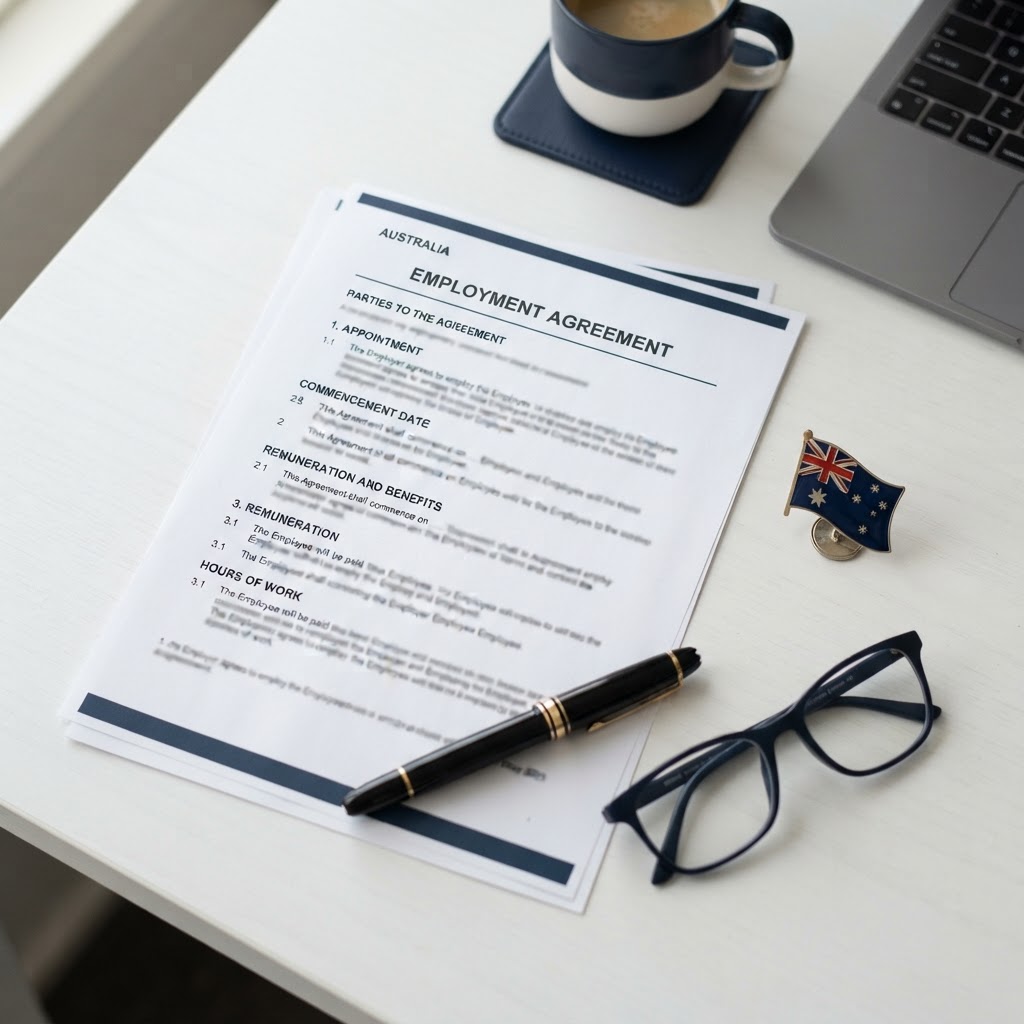
What Is an Employment Contract Agreement?
An employment contract agreement is a legally binding agreement between an employer and an employee setting out the terms of the working relationship. What surprises many employers is that a contract does not need to be in writing to be valid. Every full-time employee in Australia has a contract from the moment they accept the job, even if nothing was ever signed. The danger is that when a dispute arises, the Fair Work Commission reconstructs the terms from emails, rosters and pay slips, which costs far more than a signed document.
A written contract also cannot undercut the floor. Under the Fair Work Act 2009, any term that provides less than the NES (Australia’s 10 minimum employment entitlements) or less than the applicable modern award is unenforceable to that extent. Full-time employees are entitled to a maximum of 38 ordinary hours per week, paid annual leave, personal or carer’s leave, and notice of termination, and your template must preserve every one of those minimums.
Free Employment Contract Template: What It Must Include
Whether you download a free template or draft from scratch, a compliant full-time employment contract template in Australia needs these clauses:
- Parties and position — job title, reporting line and a duty statement reference.
- Employment type — expressly full-time, with ordinary hours (up to 38 per week) and the days or roster pattern.
- Remuneration — the annual or hourly rate, the applicable award and classification level, and how overtime and penalty rates are paid.
- Leave entitlements — annual leave, personal or carer’s leave, and any additional benefits above the NES.
- Probation — a probationary period with a clear end date and review process.
- Confidentiality — protection of client lists, pricing and trade secrets during and after employment.
- Post-employment restraints — non-solicitation clauses drafted narrowly, because broad non-competes are regularly struck down.
- Termination — the notice the employee must give, and how serious misconduct ends the contract immediately.
- Policies incorporation — a clause binding the employee to your workplace policies, so your code of conduct actually binds.
- Fair Work Information Statement — a reminder that you must give the FWIS to every new employee before, or as soon as practicable after, they start.
Each clause above appears in our reviewed Australian employment contract template library, which you can customise for the role rather than a generic overseas format. If you want a deeper walkthrough of clause drafting, our guide on what an employment contract must include in Australia covers the legal reasoning behind each one.
⚠️ A signed contract is not a shield
If a clause pays below the modern award or the National Employment Standards, it is unenforceable no matter what the employee agreed to, and the Fair Work Ombudsman can pursue underpayment penalties for every affected pay period.
Key Takeaways
Key Takeaways for Employers
- ✓Build the contract from the award up: confirm the award and classification level first, then draft every clause above that floor.
- ✓Full-time means up to 38 ordinary hours per week; write the roster pattern into the contract, not just a number.
- ✓Keep restraints narrow. A non-compete wider than necessary to protect legitimate interests will be struck down.
- ✓Delete American at-will language from any downloaded template before an Australian employee signs it.
- ✓Keep a signed copy and issue the Fair Work Information Statement on day one to stay audit-ready.
Fair Work Centre
Need help with employment contracts for employers?
Our employment lawyers advise employers only — no call centres, no generalists. Get straight answers from people who know the Fair Work Act inside out.
Free Templates
Get free employment agreement templates — Basic, Full-Time, Part-Time & Casual.
How to Write an Employment Contract: Step by Step
Step 1: Identify the modern award. Use the Fair Work Ombudsman’s award finder and confirm the role’s classification level. The award sets the floor for pay, hours, penalties and allowances, and every later term is read against it.
Step 2: Start from the NES, then build up. Write in the 10 minimum entitlements first, then add any benefits above the minimum, such as extra leave.
Step 3: Add the protective clauses. Confidentiality, intellectual property assignment, and narrow restraints of trade. Restraints must be no wider than reasonably necessary to protect legitimate business interests, or a court will refuse to enforce them.
Step 4: Set the notice and termination mechanics, including the notice period you must give (between one and five weeks depending on length of service and age) and the notice you expect from the employee.
Step 5: Issue the contract and the Fair Work Information Statement before the start date, allow the candidate time to read it, and keep a signed copy. Follow the same sequence for our basic employment agreement template if you prefer a shorter format for entry-level roles.

Employment Contract Template for Small Business: What to Change
Most small businesses inherit a template from a colleague or a US website, and that is where the risk sits. When you adapt any full-time employment contract template, change five things. First, replace the salary clause with the award classification so the rate cannot fall below the minimum. Second, delete at-will termination language, because employment at will is an American concept with no force in Australia. Third, localise the notice periods to the statutory scale. Fourth, narrow any non-compete to a radius, duration and scope a court would accept. Fifth, check whether the role is genuinely full-time, because misclassifying a part-time or casual role as full-time creates disputes about minimum hours and leave.
If you would rather not carry that risk alone, our employment contracts advisory service reviews your template against the award before your next hire signs it.
Common Mistakes That Make Employment Contract Clauses Void
Three drafting errors appear again and again in Fair Work Commission matters. A clause that pays less than the award is void, even if the employee signed it, and underpayments attract penalties for each breach. A restraint that bans a departing employee from working anywhere in the industry will be struck down, and an unreasonable restraint can even support an adverse action claim. Finally, a contract that does not match what actually happens, such as a 38-hour clause when the roster demands 50, invites a dispute over the real terms. Fixing these clauses takes minutes at drafting stage and thousands of dollars later.
This template sits alongside the rest of the paid library at employment contract templates, and the free agreements are at free employment documents.
Frequently Asked Questions
There is no official government full-time contract template, but employers can use professionally drafted free templates as a starting point. The template must then be checked against the National Employment Standards and the modern award covering the role, because a generic free template rarely accounts for award-specific pay, penalty rates or allowances.
Many providers offer employment contract templates in Word or PDF, and Word is usually better because you can adapt classification levels, pay rates and roster clauses for each role. Download a template built for Australian law, not a US or UK version, then have it reviewed against your award before you issue it to a new hire.
An employment contract agreement is the legally binding arrangement between an employer and an employee covering pay, hours, leave, duties and how the relationship ends. In Australia the contract exists as soon as the job offer is accepted, even with nothing in writing, which is why a signed written agreement is safer than relying on emails and verbal promises.
Start by identifying the applicable modern award and classification level, then draft the 10 core clauses: parties and position, employment type and hours, pay, leave, probation, confidentiality, restraints, termination notice, policy incorporation and the Fair Work Information Statement. Compare every clause against the award, and have a professional review it before signing.
The best small business template is one written for Australian law and edited for your industry award. Look for a template that names the award classification, uses the statutory notice scale instead of at-will language, and includes confidentiality and narrowly drafted restraints. A lawyer-reviewed template library beats a free overseas download every time.
Employment law is federal, so the same full-time employment contract template works in Queensland, NSW, Victoria and every other state. The differences that matter are the applicable modern award and any state-based long service leave schemes, so adjust those clauses rather than hunting for a state-specific template.
No. US and UK templates commonly include at-will termination, two-week notice and non-compete rules that either do not apply in Australia or are void against the Fair Work Act 2009. Using one risks underpayment claims, unenforceable restraints and disputes the Fair Work Commission will resolve against the document.
A contract does not need a signature to be binding, because acceptance of the job creates the relationship. However, a signed written contract is the only reliable way to prove the agreed terms, enforce restraints and defend a dismissal. Always keep a signed copy and issue the Fair Work Information Statement at the same time.
Join Fair Work Centre
Protect your business with the right HR support.
Join hundreds of Australian employers who rely on Fair Work Centre for employment law advice, HR documents, and Fair Work Commission representation.