
Quick Summary
Quick Summary
- Overtime rates come from the employee’s modern award, enterprise agreement or contract, not the National Employment Standards.
- The most common award pattern is 150% for the first two hours of overtime and 200% after, Monday to Saturday.
- Casual employees receive overtime too, calculated on their loaded casual rate.
- Sunday and public holiday work is usually paid as fixed penalty rates.
- A salary does not switch off overtime unless an annualised arrangement or section 330 guarantee lawfully covers it.
Overtime rates in Australia are the higher pay rates a modern award, enterprise agreement or employment contract requires when an employee works outside ordinary hours. Most awards pay 150% (time and a half) for the first two hours of overtime and 200% (double time) after that, with casuals paid on their loaded rate and weekend and public holiday work usually covered by separate penalty rates. Overtime comes from the instrument covering the employee, not the National Employment Standards, so the entitlement exists only where the award, agreement or contract creates it.
When are overtime rates payable in Australia?
Four triggers create overtime in most awards: work beyond rostered ordinary hours; work outside the award’s span of hours; work beyond the daily or weekly ordinary hours cap; and recall to work after a break. The Fair Work Act 2009 caps ordinary hours at 38 per week plus reasonable additional hours under section 64, but it is the award that decides what extra hours cost. The Fair Work Ombudsman overtime guidance sets out the common patterns: Monday to Saturday overtime at 150% for the first two hours and 200% after, with fixed penalty rates for Sundays and public holidays. Some awards also cap daily ordinary hours at 10, so anything beyond that becomes overtime even inside the roster.
Overtime rates for full time employees
For full-time employees, the standard pattern looks like this:
| When overtime is worked | Typical rate |
|---|---|
| Monday to Saturday, first 2 hours | 150% of the ordinary hourly rate |
| Monday to Saturday, after 2 hours | 200% of the ordinary hourly rate |
| Sunday (most awards) | 200% penalty rate for all hours |
| Public holidays (most awards) | 225% to 250% for all hours |
Exact percentages vary by award: the Clerks Award pay rates article shows the 150/200 pattern in a common private-sector award, while hospitality and retail awards often fold weekends into penalty loadings instead. Two extras catch employers out. Many awards require a 10-hour break between shifts, and without it the employee is paid overtime rates until the rest is taken; and recall after hours usually attracts a minimum payment of two to four hours at overtime rates.
Key Takeaways
Key Takeaways for Employers
- ✓Confirm the applicable award and its ordinary hours, span and daily caps before building the roster.
- ✓Base hourly rate for calculations is the weekly award minimum divided by 38.
- ✓Check the casual overtime clause, because most awards stack percentages on the loaded rate.
- ✓TOIL needs an award or agreement basis and must at least match the pay value.
- ✓Pay slips must show overtime hours and rates; wage records are kept for seven years.
Fair Work Centre
Need help with payroll compliance for employers?
Our employment lawyers advise employers only — no call centres, no generalists. Get straight answers from people who know the Fair Work Act inside out.
Free Templates
Get free employment agreement templates — Basic, Full-Time, Part-Time & Casual.
Overtime rates for casual employees
Casuals do receive overtime. In most awards the same 150/200 percentages apply, but on the casual ordinary rate, which already includes the 25% casual loading. A casual on a $33.71 loaded rate therefore earns $50.57 per hour for the first two hours of overtime, then $67.42 after. A minority of awards set different casual overtime scales, so check the specific clause before finalising rosters.
Overtime rates for Saturday and Sunday
Saturday is not automatically overtime. Where the award defines Saturday as ordinary time, staff are rostered at ordinary rates (plus any Saturday loading the award sets) and overtime starts only once ordinary hours are passed. Where Saturday sits outside the span of hours, the day is paid at overtime rates, commonly 150% then 200%. Sunday is treated differently in most awards: a fixed penalty, often 200%, applies to every hour rather than a first-two-hours scale. Public holidays sit on top at 225% to 250%.
How to calculate overtime rates
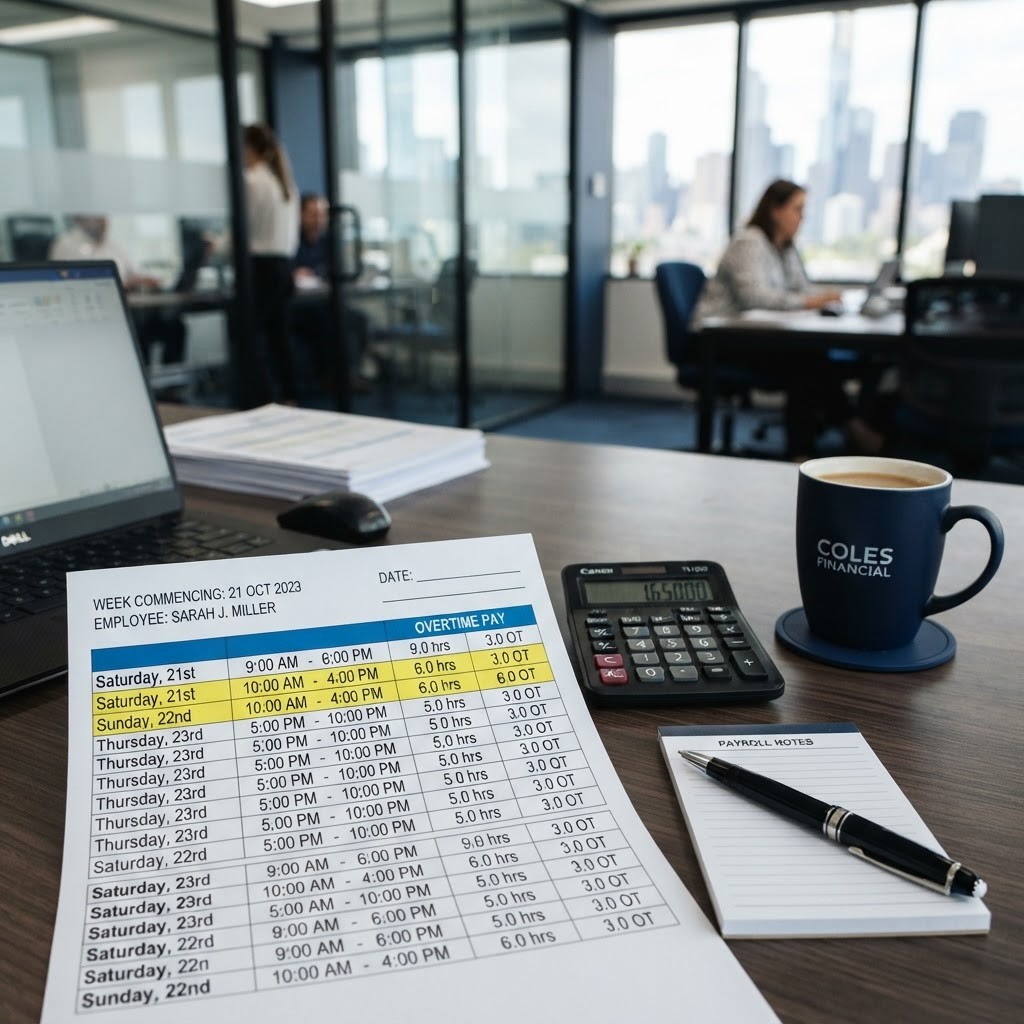
The base for all calculations is the ordinary hourly rate: for award employees, the weekly award minimum divided by 38. Using the Clerks Private Sector Award 2020 Level 1 rate of $26.97 per hour: the first two hours of overtime are paid at $40.46 per hour and later hours at $53.94, so a three-hour overtime shift costs $134.86. Four calculation errors recur in audits: using the wrong base (some awards require shift loadings in the ordinary rate), forgetting the casual loading stacks inside overtime, treating the first two hours as a weekly allowance, and averaging overtime into a salary instead of tracking actual hours. Solid payroll compliance support starts with systems that record the actual start and finish times the award requires.
Salaried employees, TOIL and when overtime rates don’t apply
A salary does not switch off overtime. If an award or enterprise agreement covers the employee, overtime survives unless a permitted arrangement absorbs it: an annualised wage arrangement under the award (reviewed at least every 12 months), or a written guarantee of annual earnings under section 330 of the Fair Work Act, which must sit below the high income threshold of $190,100. Offset clauses that quietly deduct overtime from a salary fail wherever the result is less than the award entitlement.
Time off in lieu of overtime pay is allowed only where the award, agreement or contract permits it, and the time off must be at least equivalent to the pay foregone. Our guide to calculating time off in lieu of payment sets out how each arrangement works, including how banked TOIL operates for enterprise agreement employees. Whatever arrangement is used, the paperwork must show it: pay slips must state overtime hours and rates, wage records must be kept for seven years, and gaps here give the Fair Work Ombudsman an easy path to compliance action. Our free employment law document templates include pay slip checklists and overtime policy templates that make those duties hard to miss.
Frequently Asked Questions
The most common awards pay 150% of the ordinary hourly rate for the first two hours of overtime Monday to Saturday and 200% after that, with casuals entitled to the same percentages on their loaded rate. Sunday work is usually paid at a 200% penalty rate and public holidays at 225% to 250%. There is no single national overtime rate: the percentages that bind your business are those in the modern award, enterprise agreement or contract covering the employee.
No. Private-sector overtime rules are federal and award-based, so the same award produces the same overtime rates in every state and territory: a Clerks Private Sector Award 2020 employee is paid identical overtime in Sydney, Brisbane and Perth. State differences appear only at the edges, such as different state public holidays and a small group of state public sector employees outside the Fair Work Act system.
Yes, whenever an award or enterprise agreement covers them. A salary alone does not remove overtime entitlements; only a compliant annualised wage arrangement under the award, an enterprise agreement absorbing overtime, or a written guarantee of annual earnings under section 330 of the Fair Work Act (capped below the $190,100 high income threshold) can do that. Offset clauses in template contracts fail wherever the salary would fall below award entitlements, so have them checked.
Not for employees whose award, agreement or contract provides overtime. Failing to pay it is an underpayment, and the Fair Work Ombudsman can issue compliance notices, recover underpayments and seek court penalties. Unpaid extra hours are lawful only where no instrument or contract provides overtime for that employee, or where permitted TOIL is given at equivalent value.
Yes. Casual employees covered by an award are entitled to overtime on the same triggers as permanent staff. Most awards apply the same 150/200 percentages to the casual ordinary rate, which already includes the 25% casual loading, so a casual on a $33.71 loaded rate earns $50.57 per hour for the first two hours of overtime and $67.42 after. A handful of awards set different casual overtime scales, so confirm the casual overtime clause before finalising rosters.
Start with the ordinary hourly rate: the weekly award minimum divided by 38, plus any loadings the award says form part of ordinary pay. Multiply the first two hours by 1.5 and each later hour by 2 (or your award’s percentages). A Level 1 Clerks Award employee on $26.97 per hour earns $40.46 per hour for the first two hours and $53.94 after, so three overtime hours total $134.86. Casuals calculate from their loaded rate, and Sunday or public holiday hours replace the scale with fixed penalties.
Sometimes. Under section 64 of the Fair Work Act an employee may refuse additional hours that are unreasonable, considering health and safety, personal circumstances such as family responsibilities, industry patterns, the notice given and whether overtime was flagged at hiring. Some awards also let employees elect not to work certain overtime. Refusals must rest on those statutory factors rather than convenience, so document the request and the reasons for any refusal against them.
Yes, when overtime applies to the employee. Pay slips must show the overtime rate paid and the overtime hours worked, alongside the usual pay period and gross and net details. Where TOIL is accrued instead, the record must show the overtime worked, when it was taken and the balance. Time and wages records must be kept for seven years, and incomplete overtime records expose the business to penalties even where the pay was correct.
Join Fair Work Centre
Protect your business with the right HR support.
Join hundreds of Australian employers who rely on Fair Work Centre for employment law advice, HR documents, and Fair Work Commission representation.
Related Guides for Employers
→ Payroll Compliance for Employers→ Modern Awards Compliance